Black Women’s Health Imperative Releases Report Centering Black Women in the National Menopause Policy Conversation
 New report examines the lived experiences of Black women and analyzes 171 state and federal menopause-focused bills to identify where policy is advancing — and where critical gaps remain
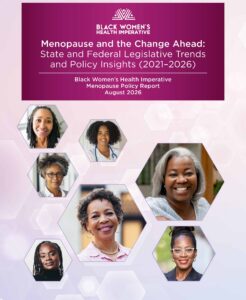
ATLANTA — August 2026 — The Black Women’s Health Imperative (BWHI) today released Menopause and the Change Ahead: State and Federal Legislative Trends and Policy Insights (2021–2026), a report that places Black women’s experiences at the center of the growing national conversation about menopause and public policy.
Menopause is a natural stage of life, but Black women experience distinct and often more severe challenges. Research cited in the report shows that Black women tend to enter menopause earlier, experience symptoms for longer periods, and face greater barriers to high-quality, responsive healthcare.
“Black women cannot be an afterthought in the national conversation about menopause,” said Joy D. Calloway, MBA, MHSA, President & CEO of the Black Women’s Health Imperative. “Our experiences reveal some of the deepest gaps in our healthcare system — from being dismissed by providers to navigating symptoms without adequate information, support or culturally responsive care. This report is about ensuring that as menopause policy advances, Black women are seen, heard and meaningfully included.”
The report builds on BWHI’s 2025 Black Women’s Menopause Study, which surveyed 1,574 Black women. Among respondents, 41% said their healthcare provider had not discussed menopause symptoms with them, 54% said they did not have enough information to effectively manage their symptoms, and 52% were uncertain about which menopause recommendations to follow. Respondents also reported significant symptom burdens, including weight gain, depression, night sweats, brain fog and fatigue.
BWHI also analyzed menopause-focused legislation introduced at the state and federal levels between January 2021 and March 2026. The report identified 171 bills, with 26 passed, 70 failed and 75 active during the study period. Legislative activity rose sharply, from just two bills introduced in 2021 to 63 in 2025.
At the state level, 28 states introduced menopause-focused legislation, and 16 states passed at least one measure. These bills addressed insurance coverage, provider education, public and patient education, research, workplace protections and health disparities. Only 21 state bills specifically addressed racial or geographic differences in menopause-related health outcomes.
The report recommends stronger research and data collection focused on Black women; greater access to clinicians trained in menopause care; expanded telehealth and technology-enabled care; provider education addressing racial bias and differences in symptom recognition and treatment; workplace protections and accommodations; and trusted community-based support.
BWHI also cautions that awareness and insurance coverage alone do not guarantee care. Cost-sharing requirements, prior authorization, provider shortages and insufficient clinician training can continue to stand between women and the care they need.
“Good policy should be measured by a simple question: Does it help women get the information, care and support they need to live well?” Calloway added. “For Black women, that means building systems that recognize our experiences and are designed to respond to them.”
Menopause and the Change Ahead: State and Federal Legislative Trends and Policy Insights (2021–2026) reflects BWHI’s continued commitment to ensuring that Black women help shape the research, healthcare practices and public policies that directly affect their lives.
About the Black Women’s Health Imperative
The Black Women’s Health Imperative (BWHI) is a national nonprofit dedicated to advancing the health and wellness of Black women and girls. For more than 40 years, BWHI has addressed critical health issues affecting Black women through research, policy and advocacy, programs, education and strategic partnerships. Its work spans maternal and reproductive health, chronic disease, menopause and healthy aging, with a focus on improving care, access to trusted health information and the health and well-being of Black women.
Media Contact:
Cieja Springer, Senior Director
Marketing and Communications
Black Women’s Health Imperative
Media@bwhi.org