Let’s Break It Down: What Does “Evidence-Based” Actually Mean?
You’ve probably heard the term “evidence-based” used to describe healthcare treatments, public health recommendations, policies, and programs. But what does it actually mean? More importantly, why should you care?
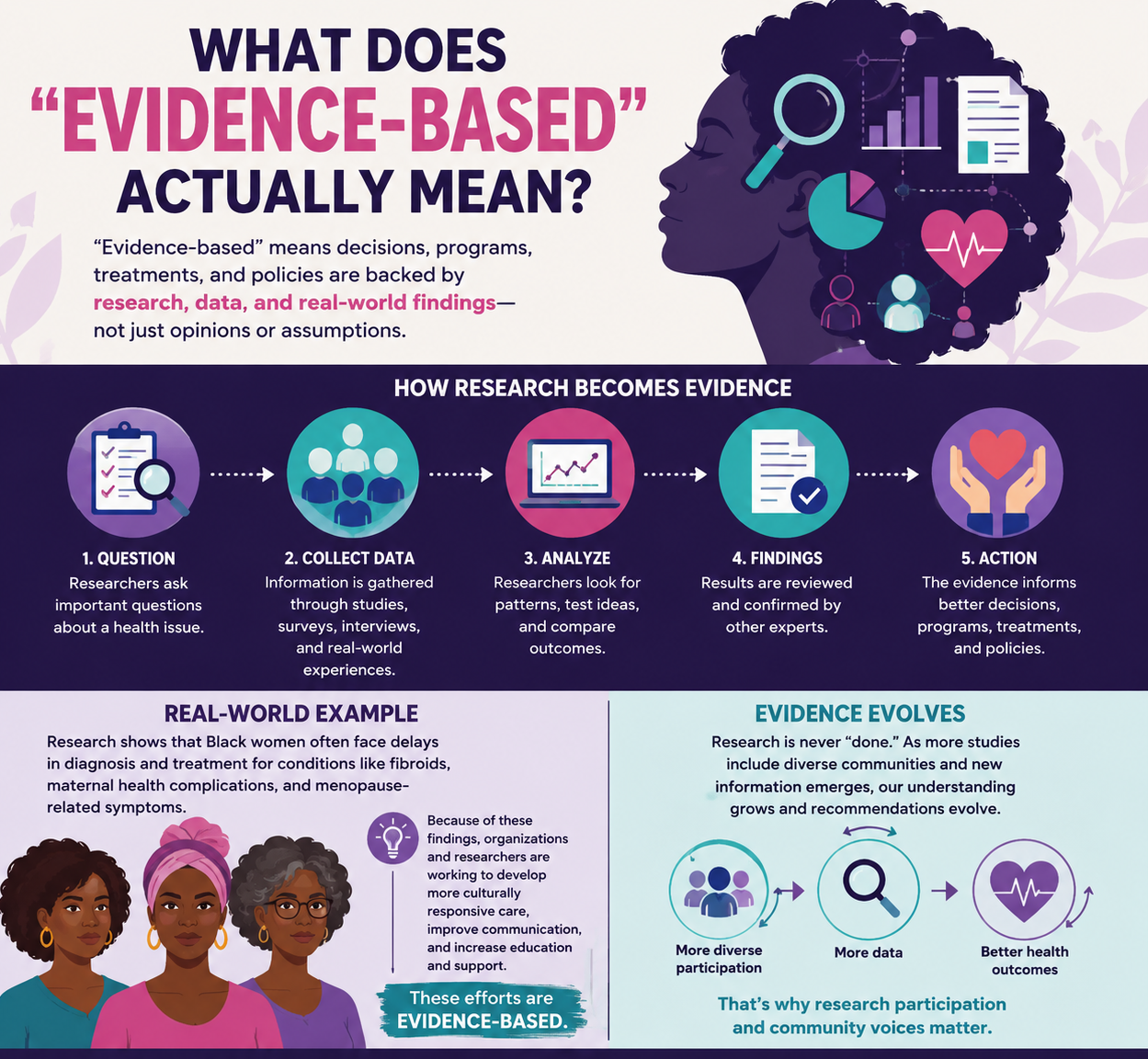
In simple terms, evidence-based means something is backed by research, data, and real-world findings rather than opinions, assumptions, or anecdotes. Researchers ask questions, collect information, analyze patterns, test ideas, and evaluate outcomes. The goal is to understand what works, what doesn’t, and for whom.
That may sound straightforward, but in today’s world, where health advice floods our social media feeds, podcasts, news channels, and group chats, understanding what counts as evidence has never been more important. Because not everything that sounds scientific is actually supported by science.
Why Evidence Matters More Than Ever
Every day, we’re bombarded with health claims. Eat this. Don’t eat that. Take this supplement. Avoid that medication. Trust this expert. Ignore those experts. The amount of health information available today is overwhelming — some of it valuable, some misleading, and some of it completely false.
For Black women, the stakes are especially high. Research has documented significant disparities in how we experience the healthcare system, including delays in diagnosis and treatment, higher rates of maternal mortality, and persistent gaps in care for conditions like fibroids, cardiovascular disease, breast cancer, and menopause-related symptoms. When evidence identifies patterns like these, it gives communities, advocates, healthcare providers, and policymakers the information needed to push for change. Evidence helps transform individual stories into documented realities that demand action.
As physician and health equity leader Dr. Aletha Maybank reminds us: “Data are not just numbers. They represent people, communities, and lived experiences.” Behind every statistic is a person. Behind every trend is a community.
When Research Gets Weaponized
One of the biggest challenges today is that misinformation often disguises itself as truth. And in many cases, it starts with a legitimate concern. People want healthier food. They want fewer chronic diseases. They want more transparency from government agencies and healthcare institutions. Those are reasonable goals. The problem comes when legitimate concerns are used to promote claims that aren’t supported by evidence.
Recently, portions of the Make America Healthy Again (MAHA) report faced scrutiny after journalists and researchers identified citations that were either inaccurate, mischaracterized, or linked to studies that did not support the claims being made. Critics argued that some conclusions were presented with the appearance of scientific authority without the evidence to back them up. The controversy offers an important lesson: evidence-based decision-making requires more than citing research. It requires accurately representing what the research actually says.
Similarly, Secretary Robert F. Kennedy Jr. has repeatedly questioned vaccine safety despite decades of scientific evidence demonstrating that vaccines have prevented millions of deaths worldwide and significantly reduced diseases that once devastated communities. Healthy skepticism is important, and blind trust is never the goal. But evidence-based thinking requires us to follow the evidence wherever it leads, even when it challenges our personal beliefs, political views, or assumptions. Asking questions is good. Ignoring the answers is not.
The Difference Between Evidence and Anecdotes
We all know someone who has said, “This supplement changed my life,” or “My friend stopped taking that medication and feels great,” or “I saw a video that said doctors have been hiding the truth.” Personal stories matter, and in fact, personal experiences often help researchers identify important questions that deserve further study. But a personal story is not the same thing as evidence.
Evidence asks whether something worked for most people or just one person, whether there was a comparison group, whether other factors were involved, and whether the results can be repeated by other researchers. Anecdotes can spark curiosity, but evidence is what helps us make decisions. That’s an important distinction because decisions affecting millions of people cannot rest on individual experiences alone.
How to Tell if Something Is Evidence-Based
The next time you come across a health claim, ask yourself these questions:
- Who is making the claim? Are they a qualified expert in the field they are discussing, or are they selling a product, promoting a brand, or building an audience?
- What evidence are they using? Is the claim supported by multiple studies, expert consensus, and established research, or is it based on a single study or personal opinion?
- Who was included in the research? Did the study include Black women and other diverse populations? If not, the findings may not tell the whole story.
- Has the information been reviewed by other experts? Peer review is not perfect, but it helps strengthen accountability and scientific rigor.
- Does the claim acknowledge uncertainty? Real experts are usually transparent about what we know, what we don’t know, and what still requires more research.
- Is the message designed to inform or scare you? Fear is often used when evidence is weak.
- Does it connect data to real people? The strongest research recognizes that numbers and lived experiences work together, not in opposition.
Why Black Women’s Voices Matter
Research is strongest when it reflects the experiences of the people it is meant to serve. For too long, Black women have been underrepresented in clinical trials, health studies, and medical research. As a result, many recommendations have been developed without fully understanding our experiences, symptoms, risks, and outcomes. That is changing, but there is still work to do.
As scientist Dr. Kizzmekia Corbett-Helaire has said, “Science belongs to all of us.” That means Black women deserve to be represented in the research, to help shape the questions being asked, and to have access to accurate information that supports informed decisions about our health.
At the Black Women’s Health Imperative, we believe evidence and lived experience belong in the same conversation. Because the goal isn’t simply to understand research. It’s to make research make sense, to help people separate facts from fiction, and to ensure that the decisions affecting our health are grounded in evidence, accountability, and the realities of our lives.